The Vibe Coding Paradox
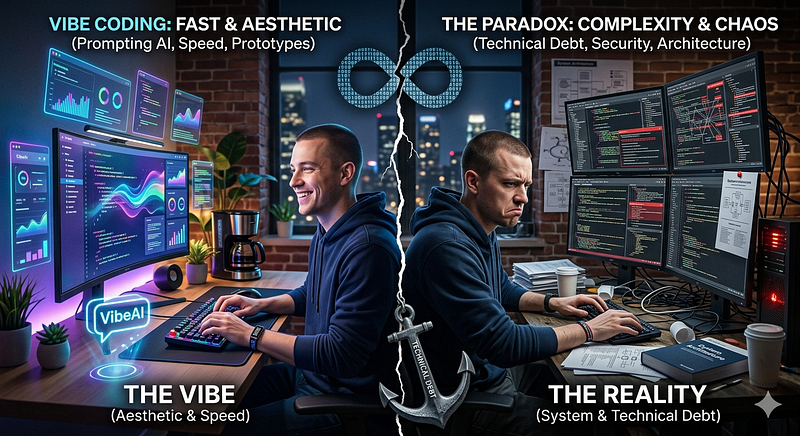
Vibe Coding has become one of the most popular movements in today’s world. While artificial intelligence has democratized the world of coding, this process has brought serious structural risks along with it.
We call this era — where writing code is now equated simply to sending prompts — Vibe Coding. But is this speed truly sustainable?
Mediocrity:
With the rise of AI, projects have become carbon copies of one another. Software projects were once built with passion and curiosity; today, applications are nothing more than “enhanced” (!) copies of each other. This rapidly diminishes both software quality and product value.
Applications that lack a soul, generated by mere commands, are turning the digital world into a pile of standardized commodities.
Depth:
It is undoubtedly easy to ship an application with Vibe Coding. Even those with minimal technical knowledge can stand up a tool with just a few prompts. However, the real problem is here: AI does not deeply understand the code.
This superficiality invites security vulnerabilities, system crashes in large-scale projects, and cyberattacks. Of course, a skilled developer can minimize these risks with detailed instructions; but for those who do not understand backend architecture or lack the drive to research, the result will be frustration.
Blindness:
The surge of Vibe Coding by those without proper knowledge is flooding the market with low-quality products. But the real danger lies with junior developers just starting their journey. When a developer turns directly to AI instead of solving a problem themselves, they atrophy their “troubleshooting” muscle.
Relying on result-oriented prompts rather than digging into the root cause allows “legacy junk” to leak into the codebase, leading to disastrous optimization. Build your own architecture, question the code, and strive to write it yourself whenever possible.
Security:
AI can provide the functionality you want, but it does not guarantee that the code is secure. As projects grow, manual verification becomes difficult, and a single overlooked vulnerability can be the end of your project.
When a security breach occurs, the “AI wrote it” excuse is not a valid defense, neither in court nor in the marketplace.
From the hacking of a personal blog to financial losses on e-commerce sites, this obsession with quick fixes can lead to irreversible damage.
Scalability:
AI can write individual functions brilliantly, but problems emerge when scaling to the entire system. Code snippets that work perfectly in small projects lead to incompatible, fragmented components as the project grows. While local models today — like Codex, Antigravity, or Llama-3 — can grasp context, their token limits and “comprehension capacity” will eventually hit a wall.
Unless you establish a sound architecture, the code AI produces will not grow your project; it will only increase your technical debt.
Financials:
Users can now have their needs met directly by AI. Many small tools that used to be paid services (such as note-taking apps) can now be obtained via a simple AI prompt. This has destroyed the economic value of simple utility applications and caused significant “pollution” in the software world.
People are no longer willing to pay for these repetitive tools because they can either build them themselves or access them for free via AI.
Sterility:
A project used to be the product of deep effort, planning, and a painful implementation process; it was slow, but it was enduring. Today, code can be produced with trivial ease.
AI produces the most probable — the “most average” — result. If everyone gives the same commands to an AI, all emerging applications will resemble one another, using the same solutions and the same piles of code. As developers lean on AI instead of seeking diverse paths, they stifle their own mental productivity.
Conclusion:
Vibe Coding is not just a tool that writes code for us; it is a dangerous domain that requires deep contemplation.
In the future, those who rise will not be those who just write or request code, but those who can architect the system, those who possess a vision and a heart, and those who can manage the system as a whole.
The true artist of software is not the one who follows the machine, but the one who follows their own intelligence.
Yorumlar
Yorum Gönder